
Troperville
Help us survive. All donations are anonymous on the wiki and unacknowledged, as we don't wish to create a hierarchy among Tropers.
Editing
Tools
Toys
|
|
|
|
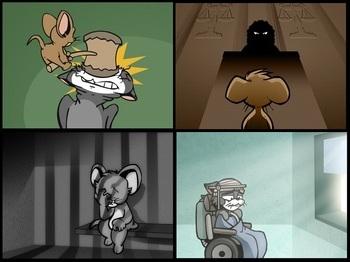
"Sometimes I think you enjoy breaking these little geniuses." "There is an art to it, and I'm very, very good at it. But enjoy? Well, maybe. When they put back the pieces afterward, and it makes them better."
Many shows subvert a trope. Other shows go further and do Deconstruction: subverting an entire genre.
A deconstructionist show will not just make fun of its genre, but attack it. Often, it will show that the genre's tropes (consciously or not) represent a very dark moral. The most common way to do this is to take a trope (often a comic one) and play it utterly realistically - showing just how bad an idea it would be in the real world. Simply put, parody that isn't played for laughs (if it does aim for laughs, it's usually comes across as more sad than funny).
Well-done deconstruction will change a genre forever; every example of it afterward is, to some extent, a response to the deconstruction. It will also inspire a ton of " Darker And Edgier" imitators that are considerably weaker than the original.
After a period of these imitators dominating the genre, there will often be a " reconstruction" movement, returning to the things that made people like the genre in spite of — or perhaps because of — the tropes that were deconstructed. (As Kurt Busiek, author of the comic book Astro City, put it, the purpose of deconstructing something is so you can put it back together afterwards, better than it was before.) Thus, it can become a Cyclic Trope.
"Deconstructionism" is also the name of a theory in academia and architecture, which, while related, is much more complex than the trope.
Works that are Deconstruction will naturally feature a lot of Deconstructed Tropes. See also Meta Trope Intro, Satire Parody Pastiche. Compare Post Modernism. Contrast Affectionate Parody. Not to be confused with the Deconstructor Fleet, which engages in Parody and Pastiche as much as it does in actual deconstruction.
Examples:
- Neon Genesis Evangelion deconstructs the Super Robot genre (and how), and many typical anime personality types.
- Martian Successor Nadesico, on the other hand, does the same thing with its Affectionate Parody of Real Robot shows.
- Super Hero comics had a huge wave of deconstruction in the '80s and '90s, caused chiefly by two examples:
- Batman: The Dark Knight Returns takes straightforward superhero action and makes it look absurd by having politics interfere. Batman's work becomes a tool for debates about "toughness on crime," while Superman's idealism makes him an easy dupe for the US government's plans for nuclear war.
- The graphic novel Watchmen is the genre deconstruction. It examines just why somebody would choose to dress up in fetish gear and beat people up. One "hero" is a sociopathic moral absolutist, one is an egomaniac, one is there simply because her superhero mother made her, and all are portrayed as human characters, with all their flaws. The series was also famous for observing how a superhero would impact our world. Some examples: USA wins in Vietnam thanks to the god-like Dr. Manhattan, Nixon stays in power when the Watergate scandal is covered up by the nefarious Comedian.
- Moore's earlier work, Marvelman (Miracleman in United States) deconstructs many aspects of Captain Marvel mythos and superheroes in general. In one particularly memorable instances, it deconstructed superhero battles by showing just how bloody and devastating they would be in a more realistic setting.
- While Kingdom Come was part of the mid-90's wave of Reconstructionist comics (made in response to the above-mentioned wave of deconstruction), its reconstruction of the Silver Age was accomplished by deconstructing the Dark Age, bringing it to its most extreme conclusion: the Nineties Anti Heroes, having killed all the villains, have become crazed Knights Templar and pretty much taken over the world.
- The League Of Extraordinary Gentlemen starts out with slightly-darker takes on Victorian heroes, but the second volume shows them sinking really low under pressure (and the ugly sides of Victorian culture that they each represent).
- Dr. Horrible's Sing-Along Blog is a stone cold deconstruction of the supervillain origin story.
- A story from the comics series Animal Man (noted for its Post Modernism) deconstructs Looney Tunes and similar cartoons: in "The Coyote Gospel," a grotesquely anthropomorphic coyote is repeatedly and brutally killed by an Elmer Fudd-style hunter obsessed with his destruction, and continuously reforms/regenerates in a most disturbing manner. Finally, in a scene reminiscent of the classic "Duck Amuck" short, the malevolent animator paints his blood in as he dies for the last time.
- My So Called Life is essentially Deconstruction of teen comedies, although the creators never declared it as such. Tropes like The Cyrano and A Simple Plan are played seriously, showing how unpleasant they would be in real life. And the parents, instead of being cartoonishly clueless, are clueless in a more realistic, and more painful, way.
- Shrek uses various fantasy/fairy tale tropes and twists them in a rather funny way. It showed a different perspective in your typical fantasy stories. Deconstructions don't have to be sad or angsty now, does it?
- The anime Paranoia Agent deconstructs sentimentality and cuteness in Japanese pop culture. One of the characters is blatantly (down to the Shout Out visual design) "what if a character from a teen comedy anime had to grow up and get a job?" And the cute things she encounters — animal mascots (especially one which she created herself), video games, cartoon merchandise — serve as an escape for people who are too immature to grow up.
- This is Older Than Steam, dating back to the novel Don Quixote by Miguel de Cervantes. It deconstructs the Knight In Shining Armor by showing how much trouble the chivalric code can cause in the real world, and the dark, unspoken assumptions behind knight's tales (i.e, true gentlemen do not need to work). After its publication people never really read them in the same way again and the genre promptly died, to this day works containing knights in shining armor are surprisingly rare (though not unheard of; there are plenty of works that are chivalric in all but name, particularly games)
- Another old example: the novel Great Expectations by Charles Dickens is a rare case of a writer deconstructing all of his previous work. All the normal tropes of Dickens novels (the Changeling Fantasy, saintly dying women, mysterious benefactors, long-lost relatives, etc.) happen like clockwork. Then these tropes are revealed to be a malevolent lie created to manipulate the hero — who has been so morally ruined that he's more like an Antihero.
- Terry Pratchett's Discworld novels started out as a simple parody of fantasy novels, but the series has now grown and evolved to include several novels that deconstruct not only fantasy novels, but fairy tales (Witches Abroad), Christmas stories and Victorian children's books (Hogfather), police procedurals (the various "City Watch" books), and other genres. They haven't stopped being funny.
- Fan Fic has a tendency to try to deconstruct the series it's based on — either deliberately or simply by pulling the loose threads in the story or setting until something breaks.
- For example, Crystal Tokyo, the Crystal Spires And Togas Future of Sailor Moon, is frequently deconstructed into a Knight Templar dystopia. Neo-Queen Serenity, Sailor Moon's future self, is described as "cleansing the Earth's people of evil". In the second season, the Black Moon Clan showed up, time-travelling antagonists who refused to be "purified" and left Crystal Tokyo forever. This naturally implies cleansing is compulsory and individual, which makes it sound like a euphemism for mass brainwashing.
- Similarly, the Federation from Star Trek, especially after Star Trek The Next Generation, is frequently portrayed as a semi-communist dystopia, only averting the worst horrors of the stereotype due to their Applied Phlebotinum. The website StarDestroyer.net is famous for advocating and supporting this view, as seen in this essay
.
- A great deal of Power Rangers fanfic (especially with the original characters) portrays the characters as if the constant power losses, mind hi-jackings, and secrecy actually had the profound psychological effects one would expect these sort of things to have on a teenager.
- Some Kim Possible fics have her clear "beat the bad guys, save the world" morality crash against the intractable problems of the world, leading her to crack up or go rogue. Others have her Evil Counterpart Shego explain moral relativism to her.
- The merciless deconstruction (or Affectionate Parody) of various High School character tropes that went down in Not Another Teen Movie may very well be credited to the fall out of teen movies in the early 2000s.
- The webcomic Megatokyo is described by its author as a subtle deconstruction of the Dating Sims he enjoys, with a mix of lampshade hanging, playing it dead straight and showing the darker side of each trope, especially Unlucky Everydude, Robot Girl, and Cleaning Up Romantic Loose Ends. At least one of the characters might well be aware of this...
- Sailor Nothing loves showing just how jarringly, horrifically, nightmarishly different the characters' lives are from magical girl anime. Several of them even watch an exaggerated, stereotypical version of such shows; the main character actually watches it to escape her life.
- Jidai Geki films underwent an increasingly cynical Deconstructionist phase during the 1960s that arguably led to the genre going out of vogue for a good deal of the 1970s:
- Yojimbo
- Sanjuro
- Samurai Assassin
- The Sword of Doom
- Hari-kiri
- Similarly, Western films in the 1960s went through a Deconstructionist phase:
- A Fistful of Dollars — a remake of Yojimbo
- For a Few Dollars More
- The Good, the Bad, and the Ugly
- Hang 'Em High
- The Wild Bunch — John Wayne is said to have complained that this film "killed the Western".
- Even though it kinda started with The Searchers, in which Wayne's hero is unabashedly racist towards Native Americans.
- High Plains Drifter
- El Topo
- Django
- Worthwhile deconstructions later on include Robert Altman's Mc Cabe & Mrs. Miller and Jim Jarmusch's Dead Man.
- To a certain extent, the 2006 James Bond film Casino Royale deconstructs earlier Bond films through features such as a conversation mocking the Double Entendre names of previous Bond girls, Le Chiffre's comment about preferring simpler methods of torture to the Death Traps endemic of the series, having Bond respond "Do I look like I give a damn?" when asked how he wants his martini, and generally treating his profession as an assassin more literally. At least some of these features were present in the original novels, making the film something of a Reconstruction as well.
- While the first two Metal Gear games played everything fairly straight, the Metal Gear Solid series is intended as a deconstruction of action movies (and, to a lesser extent, video games), twisting tropes common to them around in extremely horrible ways to establish how damaged everything and everyone would have to be for an action movie scenario to work in the real world. By the second game it's way out into the nastiest parts of the Deconstructor Fleet territory, shamelessly attacking fandom, the video game industry, the expectations of fans and even its own prequel and characters. Some would argue it goes a bit too far, to the point where it feels very painful to play a game which clearly hates you so much.
- Similarily, Metal Gear Solid 4 raises the question of what exactly happens to Action Heroes after the action movie ends. The choices that are presented are dying in a blaze of glory, suicide, or fading into obscurity.
- The film Gwoemul (The Host) was something of a deconstruction of the monster movie genre, as well as a political comment. It starts with a re-enaction of a real pollution incident that showed just how self-centred America could be and how useless the Korean government was, and then created a mutated tadpole (or something) monster that causes destruction and terror. And the government's first reaction is to quarantine the area because they're afraid it's got diseases, doing almost nothing about the creature itself. It takes the fairly standard Disaster Movie trope of the wash-out dad who must become a hero to save his child, gives a painful recounting of why he's a wash-out, and shows his screwups as having some truly tragic consequences. Along the way, it lampoons military history (with a thinly-veiled parody of the Agent Orange bioweapon). On the other hand, it also portrays youth protesters as sort of like Don Quixote, whichever way you want to interpret him. If you're not South Korean, however, you'll miss most of this, and just see it as an intelligent monster movie.
- The anime and manga Narutaru (Shadow Star) deconstructs the mons genre in a very disturbing and bloody way. To control their companions, the children have a psychic link with them which can take a heavy toll on both their body and mind, and some become very aware of the power they have and abuse it (some to the point of mass murder), like most kids in the real world would.
- The Pixel Art Comic Kid Radd
, while largely light in tone, presents a "video game characters living in videoland" scenario where it's a very real problem that many inhabitants are innately heavily armed and know nothing but killing. They know why they were created, and they don't like it. The player character Radd goes from slacker to Determinator because he always had the latter's mindset, but started his days in a game under the player's control, so he had to learn initiative completely from the ground up. Upon being freed, Radd needed instructions to walk independently.
- Good luck watching another crime drama, even a relatively realistic one, after watching The Wire's rather brutal deconstruction of the genre.
- Bokurano (written by the same person who made Narutaru) is a Humongous Mecha deconstruction that showcases only too well the destructive side-effects caused by giant robot battles, not to mention the immense psychological stress caused by having a bunch of kids (who all have their own personal tragedies on top of it) responsible for the continued existence of planet Earth. And then they throw in the fact that the Super Robot they must use is fuelled by the pilot's Life Force, meaning they're all dead even if they win, and we start crossing into Diabolus Ex Machina territory.
- Santa movies aimed at adults as well as children usually attempt to deconstruct the Santa mythos — a recent one being Fred Claus, which implies Santa has a bad sex life due to his weight.
- No mention of Cloverfield yet? A giant monster movie where, instead of focusing on the monster and the awesome destruction it causes, or the super soldiers fighting it, we focus on the people caught in the catastrophe, and what a completely tragic, horrifying experience a kaiju attack would be in real life. It also shows how the average person in such a thing would really have NO DAMN CLUE about the monster's origins, its ultimate fate, or really anything other than "It's here and it's killing everyone!"
- The original Gojira did a bit of the same thing with a tragic consequences, which makes Cloverfield almost a Reconstruction at the same time as it deconstructs.
- Marvel comics Marvels and Ruins similarly focus on the impact of superheroes on an "average" person.
- Soon I Will Be Invincible is a Superhero novel, revolving around Doctor Impossible breaking out of jail to try and take over the world (again)... all the while wondering if he's done the smartest things he could do with his life and vast intellect. Most of the other characters are Captain Ersatz-es of other popular comic book archetype characters, with realistic human flaws added.
- The movie Funny Games is intended as a deconstruction of the "torture porn" sub-genre of horror movies by presenting it in the most bare-bones and disturbing way possible. If you enjoyed the movie, you didn't understand it.
- Arguably, Boris Strugatsky's "The Powerless Ones of this World" is a deconstruction of much of his own and his late brother's earlier works. Perhaps most prominently, "the Sensei", who is a wise old mentor (a fairly typical character for many Strugatsky novels), turns out to have been not only a Trickster Mentor, but also the initiator of the Xanatos Gambit that dictated much of the plot and was aimed at forcing the main character to unlock his full abilities. It succeeded, but not before making said main character a nervous wreck, inducing quite a Bitter Sweet Ending and causing much remorse to the mentor himself. Additionally, the topic of the Progressors
is briefly brought up; one of the characters muses that the Sensei might be acting as one on Earth, and that he had, despite some occasional successes, failed miserably.
- Robert Smigel's Saturday Night Live 1998 animated short "Titey" is a merciless deconstruction of the then-current trend of Disney and Don Bluth trying to tell more adult stories yet still subjecting them to Disneyfication so as not to lose family audiences, even if they were inspired by actual tragic events. It's a mock trailer for an animated version of Titanic with Napoleon as a villain, Anne Frank as a heroine, and an ending where the ship doesn't sink and is reunited with its mother thanks to the encouragement of Talking Animal friends. Incredibly, Gilbert Gottfried, Whoopi Goldberg, and one of Disney's own trailer announcers participated as voices in this sendup despite all having worked for the company at some point. Smigel went on to other cruel parodies like "Bambi II" (years before such a film was actually made, taking on Disney's direct-to-video "cheapquels"), and "Journey to the Disney Vault" (regarding unpleasant realities and urban legends of the company's history), tearing into Disney's Cash Cow Franchise mentality.
- Smigel's parodies are often less than affectionate; several times he has parodied Anvilicious children's entertainment to satirize the prejudice of, and Demonization used by, various religions. Consider "Religitables", a Veggie Tales parody where the horrors carried out under the banners of various religions (witch hunts, terrorism, the Catholic church child-abuse scandals) are brushed off and even celebrated.
- There can be a very good case made for The Venture Bros being a deconstruction of Johnny Quest and Doc Savage-style stories. Some say spoof, some say deconstruction, some say both.
- The Doctor Who episode "Midnight" takes the basic components of a regular DW episode and deconstructs the hell out of it. The fact that the Doctor is clever and mysterious works to his disadvantage, the alien creature has no name and no shape, no Rubber Forehead Aliens, Humans Are Bastards instead of being special, and in the end, the Doctor doesn't save the day, a nameless character previously used for comic relief does. The Doctor doesn't even know what it was, doesn't have any answers for Donna, and ends up just as shaken as the other passengers. Add in Nightmare Fuel Unleaded and you get one hell of a Bottle Episode.
- With A Companion to Wolves Elizabeth Bear and Sarah Monette does this to all bonded companion animal stories, especially Anne McCaffrey's Dragonriders Of Pern.
- The webcomic Alien Dice is a deconstruction of Mons and especially Pokemon. The eponymous Alien Dice is a Deadly Game of Gotta Catch Em All. Here, any species, humanoid or animal-like can be turned into a mon and get captured when defeated by players. Also, the "mons", despite their Healing Factor do suffer badly in battle.
- Who could forget this
remarkable deconstruction of Super Mario?
- Stephen Sondheim's Into the Woods spends its first act as simply a retelling of the stories of Jack and the Beanstalk, Little Red Riding Hood, Rapunzel, and Cinderella, all tied together with the story of a baker and his wife who are cursed with infertility unless they can procure certain items from all four. In the end it looks like everyone's gotten what they want and is happy, but suddenly the narrator announces "To be continued!" Act two begins with the idea that the giant was just minding his own business when Jack came up the beanstalk and killed him, and just builds from there into an incredibly brutal Anyone Can Die Deconstruction of fairy tales.
- War Of The Worlds, the conventional (i.e. straight-forward invasion, not through use of Pod People or similar infiltration) alien invasion story (accept no substitutes) had the narrator having very little knowledge of what the hell was going on (and what he did know was because of his profession as a journalist or from reports after the war). He was unimportant. Basically every conventional Alien Invasion story between the original War Of The Worlds and Steven Spielberg's adaptation (and the Dueling Movies it spawned) had the main character remarkably well informed and important, if not the central player in the defense of Earth (there were a few exceptions to this... like some of the other adaptations of War Of The Worlds and some of the storylines in World War). After the release of the Spielberg version, some reviewers called it a deconstruction of other Alien Invasion movies, but really, it was a reconstruction.
- Enchanted is about as close to a deconstruction of other Disney movies as you're ever likely to see a Disney movie get.
- Family Guy does a particularly nasty deconstruction of Loony Tunes and it's Amusing Injuries, wherein Elmer Fudd is out "hunting wabbits", shoots Bugs Bunny four times in the stomach, snaps his neck amidst cries of pain, and then drags him off leaving behind a trail of blood.
- Megan's whole initial story arc on The Sueniverse was a harsh deconstruction of the typical The Phantom Of The Opera Mary Sue Fan Fic. Whereas most girls from the modern era with crushes on Erik and end up in the Phantom's realm in fanfic are played as the answer to his romantic problems and love him as he is (and he loves them in return), Megan was denied by Erik, then eventually allowed to sleep with him, became pregnant with a daughter he refused to support when he saw that the baby was as deformed as he was, and eventually took up the post of "Erik's verbal punching bag". By the time she escaped from him, he'd nearly broken her. The moral? His face aside, Erik is canonically too much of a jerkass to really return affection, no matter how much he may long for it.
- A lot of John Tynes and/or Greg Stolze work features this. Unknown Armies, for instance, deconstructs the Urban Fantasy setting, the novel A Hunger Like Fire deconstructs the trope of the sensual vampire temptress and the RP Gs Godlike and Wild Talents deconstructs superheroes stories set during World War 2 and the Cold War respectively.
- Looney Tunes director Chuck Jones often used deconstruction on his cartoons. The best known example is Duck Amuck: First the scenery changes, forcing Daffy to adapt. Then Daffy himself is erased and redrawn. Then the soundtrack fails, then the film frame, and so on until Daffy is psychologically picked clean. Another example is What's Opera, Doc?, which takes the base elements of a typical Bugs Bunny cartoon and reassembles them as a Wagnerian opera. (Conversely, you could also say that it takes the base elements of Wagnerian opera and reassembles them as a Bugs Bunny cartoon.)
- The webcomic It's Walky could arguably be seen as a deconstruction of the goofy 1980s cartoons creator David Willis is a fan of (mostly GI Joe and Transformers). Sure it features a unique special forces group- SEMME (who were initially based on GI Joe) with an eccentric line up of operatives, who routinely foil the insane schemes of a Harmless Villain, but the eccentric operatives are soon revealed to be a bunch of dysfunctional screw-ups, and the Villian is in fact Not So Harmless.
- Mass Effect spends just as much time deconstructing popular sci-fi tropes as it does playing them straight.
- Foucault's Pendulum deconstructs its genre by examining the motives people have for believing in conspiracy theories. These include the exertion of control through secrecy, a frustrated creative instinct, and the pathological desire to see every event as a symbol of something deeper instead of as itself. Ultimately, people who devote their lives to these theories are portrayed as fools who are too wrapped up in their own fantasies to realize that it is all utter nonsense.
- This trope is basically Robot Chicken's raison d'être.
- When Griffith is introduced in Berserk, he's the textbook definition of a Canon Sue: He's an excellent swordsman on par with series Badass Guts himself, a brilliant tactician and a Bishonen, with a drive to make his dream come true and the uncanny ability to draw people to him and make them believe, who has every woman including the female lead in love with him. But as the story progresses, Guts decides that he no longer wants to be a part of Griffith’s dream and elects to leave the Band of the Hawks, which requires defeating Griffith in another duel, which he does with one stroke that breaks Griffith’s sword. At this point, things start spiraling downwards. In the throes of a Heroic BSOD, Griffith seduces Princess Charlotte and spends a night with her, only to get caught and imprisoned when he tries to leave. From there, he gets tortured for an entire year to the point where he becomes only a shell of the person he used to be. He is rescued by Guts and the Hawks and can only watch as all eyes shift to Guts as the man overcomes everything before him, including a demon. When his friends learn the true extent of Griffith’s injuries and that he will never recover, they talk about disbanding and following Guts instead. Griffith then resigns himself to believing that he can live a peaceful life with Casca instead, only to find out that she has moved on and is now in a relationship with Guts. With nothing left to live for, Griffith snaps, activating his Crimson Behelit and summoning the Godhand. And from there, things go straight to hell for everyone in short order.
- Berserk also deconstructs the Changeling Fantasy by using it as a tragic plot point. Rosine is driven to believe that she's the center of a Changeling Fantasy by parental abuse, and runs away to find the fairies who are said to live in a nearby valley. After failing to find them, she is confronted by her parents. After being knocked around a bit by her father, her Behelit activates and she sacrifices her parents to the Godhand to achieve her dream. That's not all though. She begins attacking nearby villages, killing all the adults and kidnapping the children to turn them into demonic versions of fairies, believing that she created a paradise for children and that adults oppress children out of selfishness. It also deconstructs the "king supports young, rising general of common birth" trope by wanted to have sex with his own daughter out of the stress being a king causes and secretly wanting Griffith to become King so that he can be relieved of the loneliness of the throne.
- Supernatural brutally deconstructed Heroic Sacrifices with Dean's "Deal With The Devil" storyline. He knows it was selfish and only did it because he should have stayed dead, feels like he's fucked up so much that he deserves eternal torture, he can't be without his brother and because John told him to look after Sam at all costs. For his part, Sam thinks it was self-righteous, hypocritical, suicidal and extremely selfish. As for the others - Bobby finally realizes how broken Dean was and how much he hates himself, both the Crossroad Demons call it needy and Azazel knows it was self-destructive, pathetic and self-loathing. So Heroic Sacrifices? Not so noble after all - more like selfish, pathetic, destructive and so very suicidal.
- Not forgetting Sam goes to extreme lengths to attempt to save Dean in the same manner and in the Groundhog Day episode where Dean dies and Sam spends months of brutally tracking down Dean's killer.
- And not to mention that it might have been pointless anyway. In John's case, Dean looked very much like he was going to give in to the Reaper in In My Time Of Dying and as for Dean/Sam, Sam was at peace and he had been saved from turning into the Anti-Christ. So everything that has happened from now to when Sam was brought back, is really all Dean's fault. Nice going, Dean.
- The Gruen Transfer analyses and deconstructs advertising.
- Wuthering Heights deconstructs the idea that All Girls Want Bad Boys, by showing exactly what happens when girls fall in love with troubled, angry men. Heathcliff is a 'bad boy', and Bronte shows exactly what this means; he's unstable, vindictive, violent, selfish and vicious. The relationship between Heathcliff and Catherine is depicted as being intensely passionate, but also intensely unhealthy (not least because they may or may not actually be brother and sister), and Heathcliff's response to being spurned for another man is to embark on a single-minded crusade of vengeance that ultimately results in the ruination of both lovers and their immediate families for absolutely no point whatsoever. As if this wasn't enough to illustrate the point, Edgar Linton's foolish sister Isabella elopes with Heathcliff because she's attracted to his bad-boy image. She gets what she wants, but not in the way she expects; an abusive husband who is openly contemptuous and violent towards her, and makes no secret of the fact that he only married her to get at her brother. This hasn't stopped a Misaimed Fandom growing around Heathcliff, however, who even to this day is considered a model of a romantic hero despite the fact that he's pretty much a sociopath and Bronte intended to make this absolutely clear.
- It also shows that what happens when good boys fall in love with troubled, angry women who are in love with said troubled, angry men...
- M Night Shyamalan presented deconstructions of Super Hero and Alien Invasion movies with Unbreakable and Signs. In the first, the main character has no idea about the nature of his powers or about how he should use them. In the second the lead just tries to keep his family alive while leaving the fight to the army.
- Albeit Telenovelas are rarely prone to deconstruct the genre, a Colombian one named "La mujer en el espejo" deconstructed the hell out of the archetypal plot of "Former Pollyanna is betrayed by her love interest and gets into a Roaring Rampage Of Revenge via
Unnecessary Makeover becoming fashionable and ruthless". According to this one, the only real way one no one could recognize you is having a Deal With The Devil to literally transform into another woman. Pity that you now are So Beautiful Its A Curse, your family obviously doesn't recognize you, mirrors show your real appearance (who becomes your detached conscience and berates all your bad decisions, including the aforementioned deal), and your love interest liked you the way you were.
- Red Vs Blue The Blood Gulch Chronicles takes many first person shooter tropes and twists them. Everything from capture the flag, to why there are two bases in the middle of a box canyon with no strategic value, and Respawn.
- Interestingly, the new series called Reconstruction is a deconstruction of the parodic nature of The Blood Gulch Chronicles. Caboose is tied up in the brig due to his self destructive tendencies. Grif and Simmons face the firing squad after selling all the ammo to the Blue team. The reason that all the red and blue conflicts were pointless squabbling over an equally pointless flag and base is revealed to be a conspiracy by command. However, since that is a deconstruction of a deconstruction, arguably that makes it a Reconstruction as all the video game tropes are being put back together.
- Well not really. It's kind of like making a fake of a fake doesn't give you the original back. They're not putting any tropes back together, really, they're just taking apart the ones they replaced the original videogame tropes with.
- A deconstruction of a deconstruction isn't a reconstruction. Think of derivatives: the derivative of a derivative isn't an antiderivative (a.k.a. indefinite integral), its the second derivative.
- Aside from its take on Ayn Rand's philosophy, this troper considered Bioshock a deconstruction of action-oriented FPS games, as the game brings forth a world where people can conjure semi-magical abilities that seem to have no use other than warfare, specifically warfare in a video game, and builds its mythos from there.
- Mad Magazine routinely uses deconstruction in its humor. Whenever it parodies a comic strip, television show, or other continuous series, trust Mad find some deconstructionist way to kill off the main character or irrevocably change them.
- The infamous Simpsons episode "Homer's Enemy" is a deconstruction of the general weirdness and insanity of its setting, showing Frank Grimes, a man who had to struggle for everything he got in life, still living fairly cheaply despite having a strong work ethic and comparing him to Homer. Well, you can imagine. The question was "What if a real-life, normal person had to enter Homer's universe and deal with him?". After Frank's (tragic) death, Homer is seen sleeping during his funeral and in a drowsy state, tells Marge to change the TV channel, bringing everyone to laugh. All during his funeral. The episode was disliked by some for carrying a too dark and cynic tone.
- The Melancholy Of Haruhi Suzumiya seems (to this troper, at least) to be a deconstruction of its genre, basically stating that the only possibly way for an improbable universe like this to exist is that the main character has to be warping the world around her to make it exist. It also seems to deconstruct tropes like First Girl Wins and Official Couple a fair bit, as things seem set up (again, by the first girl Haruhi) so that it's physically impossible for Kyon and Mikuru to become the Official Couple, despite his clear attraction, simply because Haruhi does not allow it.
|
|