

The following is a product advertisement. You are going to be bombarded by visuals of great looking products, and then entertained by motorsports eye candy. Do not resist the temptation to purchase the products when prompted to do so. Enjoy!"
 , shamelessly lampshading the phenomenonnote
Otherwise known as a "plug" or "writing commercials right into a show". The practice of prominently displaying or talking about a recognizable product in a program, in exchange for some consideration from the manufacturer, usually monetary. The manufacturer hopes to cause The Red Stapler effect, but it far more often results in snarky comments from the peanut gallery.
This trope isn't always invoked for mercenary reasons; many times it's just more realistic for someone to be in a shopping mall and walk past actual brands rather than unnamed Brand X. Or a world set 20 Minutes into the Future won't have suddenly lost the culture of billboard advertisements and product logos which defines the modern day. Real brands add veritas in these cases. Plus some filmmakers striving for as much realism as possible would rather use recognizable products than Brand X. On the other hand, even when it begins with the best intentions, contractual obligations to have the dialogue actually mention a placed product can easily turn malignant.
The least subtle version of this kind of embedded advertising is the Enforced Plug, which, in America, was common in early television (when the commercials literally were considered more important than the programming) and still is in radio.
With reruns, DVD and downloads, this can be the gift that keeps on giving for advertisers. After all, the commercials that aired on the original broadcast aren't retained in any of these. Product placement is, at least most of the time, though there have been instances of company logos being digitally blurred out for things such as television broadcasts of movies, if the sponsoring company didn't pay for the additional product placement in these broadcasts. It can also backfire in the case of a 20 Minutes into the Future production that happens to feature a product or brand that in real life ceased to exist by the time the production was set (a prime example being Pan Am, an airline featured prominently in the 1968 film 2001: A Space Odyssey, which ceased to exist by the time the real 2001 rolled around. note )
This can occasionally be Truth in Television, since people who enjoy a given product are naturally more likely to say good things about it and/or recommend it to their friends — and, of course, it's not uncommon to name-drop brands in day-to-day conversation (see the genericizing of Coke and Band-Aid, despite the latter's best efforts). It starts to get a little gratuitous if everyone in the work, good or bad, drinks the same brand of beer, though... and if a character refers to a product exclusively by its "official" name (it's not just a phone, it's not just an iPhone, it's the iPhone 12 Pro Max, thank you very much), all bets are off.
When adding examples, there's something to remember: Not all products visible in television or film are the result of product placement. For a work to qualify, there must be some indication that a deal was made between the brand and the studio, such as a "product placement considered by (Insert Brand Here)" in the end credits of a film/ show, a "P" logo placed at the start of the show (which is legally required in the UK), or some form of Word of God to back the claim up. After all, sometimes background logos are just unavoidable, or producers just choose a product for other reasons, and there's no exchange of money with the manufacturer in those cases (One notable example, 2001: A Space Odyssey, which used Product Placement for a rather specific reason: To make the future presented much more plausible to audiences in 1968), so don't assume that if a brand logo is showing that it must be paid for by the studio, there's a good chance no deal existed to begin with if it wasn't declared in some way.
Some viewers find product placement to be more offensive than sex, violence or the Seven Dirty Words, to the point where parental movie review websites often make a point of singling out films with excessive (or, sometimes, simply any) recognizable brands or products, especially children's works, whose target audience are vulnerable to unhealthy advertising.
Product Placement from different companies in a single medium can lead to a Massive Multiplayer Crossover if their products are being competed directly instead of being mere background objects, for the Rule of Cool.
For two particular examples, see Everybody Owns a Ford and its computer equivalent, Everyone Owns a Mac.
Compare Merchandise-Driven, Product-Promotion Parade, and Advertisement Game. Contrast Brand X and Product Displacement. See also Celebrity Endorsement (when a character from a show is endorsing the product), Parody Product Placement (when it is done in an extremely over-the-top, self-aware way), Destroy the Product Placement (when the product is damaged, broken or destroyed), Prop, and Console Cameo (when the product is required to see the placement in the first place).
History — brought to you by delicious Brand XTM!
The practice began in the early days of American radio, with companies lending their names to title programs as a way for funding them. The Secretary of Commerce, which licensed radio stations during most of the 1920s, prohibited direct advertising. By 1930, advertising was permitted, but the practice remained for years. Slowly the shows set themselves apart from the ads, with announcers shilling for a product, while the characters had an adventure. Product placement also was frequent during the early days of television, with characters shilling for their sponsor at the end of an episode. However, a quiz show scandal in 1958 forced networks to control their programs, instead of the sponsors. Product placement transitioned to movies until the mid-1990s, when TV regulators relaxed the rules against products appearing outside of ad breaks.
In the UK, product placement was banned for a good 60 years on commercial channels, with the exception of the broadcasting of sports matches (particularly football and rugby)note but a law banning paid product placement was rescinded, effective February 2011. It's now allowed, but only on commercial channels, children's programs cannot include product placement, and it absolutely cannot include product placement for any sort of sugary junk food. As of writing, The BBC's commitment to commercial-free television is still Serious Business indeed.
It's still prohibited in Canada. A dishwasher manufacturer can recommend a certain brand of tablets, but the host of a cleaning show can't — in fact, they can't even show the brand name on screen.
In the movie The Great Man a radio personality mentions name-brand products on the air for personal gain. The movie was made in 1956, making this Older Than They Think. Indeed, there is (possibly apocryphal) evidence that suggests that merchants in Ancient Greece would attempt to bribe playwrights at drama festivals for favorable mentions of items in their plays. Someone epically telling the audience how great figs are could be quite good for business.
In the 2020s, with tech-savvy consumers having more and more ways to digitally block or otherwise avoid advertising, product placement is becoming increasingly attractive to advertisers. A consumer with an ad blocking app may be able to skip the advertising for a new Cool Car that goes before or after their favorite show, but they can't get around seeing that sexy sportscar if the hunky hero drives it on the show.
This trope is often parodied; for that, see Parody Product Placement.
Examples — a large variety as only Heinz® can bring it to you!
- The Dualvertisement is where one product's commercial includes a plug for a different product.
- A commercial for a dating site where the guy chatting up his partner jokingly mentions a "study" that people who own iPhones have more sex. Take a moment to let that sink in: They are advertising a product in an advertisement for another product. Not only that, but the same commercial even has the other person on the date mention Android, one of the iPhone's biggest smart phone competitors!
- One e-trade commercial has the man onscreen state that he made enough money using the service to buy seven monitors; six to watch the market, and one to "regulate chumps in Gears of War."
- A Kellogg's SmartStart Healthy Heart features women doing healthy things like yoga, exercising, and playing Wii Sports.
- Toyota's 2011 Lexus icIS is advertised using Yamaha drum equipment. According to The Other Wiki, Toyota and Yamaha made a capital alliance in 2000., though Yamaha had been developing engines for Toyota since 1967.
- The directory inquiries service 118 118 once had a daily advert in British newspaper Metro in the form of a short comic strip. Bizarrely, many of these strips featured blatant plugs for other products.
- Sprint's ads for its "Now Network" namedrop services like Twitter. Which makes sense, since a lot of people tweet from their phones. Mentioning specific websites to buy shoes, or saying that X amount of money generated by sales of Y is enough to build a Dunkin' Donuts...in space, not so much.
- A couple Geico ads have also advertised Helzberg Diamonds as well. Both are owned by Berkshire Hathaway.
- Super Bowl ads costing 5 million per 30 seconds has brought this to the big game. The most memorable was the Bud Light Mid-evil Times setting that gets destroyed by a dragon and the last Season of Game of Thrones.
- Ever bought a T-shirt with a product design or logo on it? As Calvin and Hobbes once pointed out, every time you wear that shirt you turn into a walking example of this trope. A good example of this is in the history of English professional football kits. For many years, clubs paid manufacturers to make their kits, and the manufacturers loved it: product placement which the buyer was paying them for. Eventually the clubs got wise, and the manufacturers now pay the clubs.
- The makers of Red Bull — sure, they're far from the first to sponsor sports teams and athletes, but it got to the point that they amassed what amounts to a media empire where they established magazines, put up their own Formula One racing team (or two evennote ), owned magazines, record labels and even a clothing line of all things. YouTuber Company Man remarked that the company got so big and became so well-known for its pervasive brand marketing that they are more of a media house than a beverage firm.
- Front Row Joe: When the characters sing about the refreshments you can buy at the theater, they will often show boxes, cups, and/or logos of real snack food and soda brands.
- Comedian Dane Cook name-drops so many brands in his act that it'd be more shocking if he wasn't paid to do it.
- A well-known series of Hostess Fruit Pies ad comics were featured in many comic books during the 70's and 80's. The best-remembered ones were those from Marvel and DC Comics, which featured superheroes using Hostess products in extremely gratuitous ways to defeat villains, often by either distracting them with Hostess Fruit Pies or Twinkies, or offering them the snacks in exchange for their surrender. The ad campaign was also part of other comic publications, but as their stories were comedies, rather than superhero action, they were able to incorporate the products in more believable (and therefore less memorable) ways.
- There was a Golden Age Captain Marvel story called "The Mechanix Illustrated Adventure" which was basically a 7-page house ad for what was then Fawcett Publishing's flagship non-comics title. MI was also first in line for house ads in Fawcett Comics, they were understandably eager to convert their comics readers into MI readers.
- Invoked in a Sturmtruppen strip where there's a sudden and blatant product placement. The soldier who did it then explains that Bonvi had to resort to it because the newspaper isn't paying him anymore for his strips.
- "Victory by Computer" was a ''Superman one-shot comic meant to promote the then-new TRS-80 computer. Hence, Supergirl feeling thrilled to find that specific computer brand when she breaks into a criminal lair's storage room.
- In Raymond Briggs' The Man, the title character is a Picky Eater and insists on the boy buying him his preferred food brands, like PG Tips, Coco Pops, Mother's Pride bread and Frank Cooper's Oxford Marmalade.
- Madam & Eve promotes its live-action TV adaptation (and hangs a lampshade) in this strip.◊
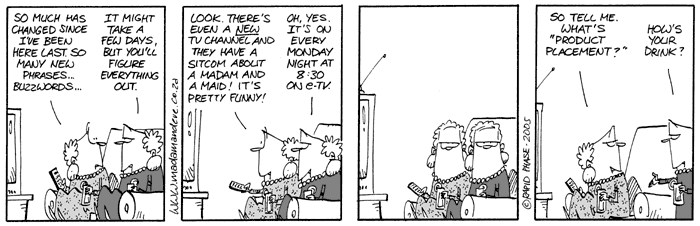
- Always Visible: The work mentions Tandy's microcomputer and alcoholic liqueur Pimm's.
- Calvin & Hobbes: The Series has the titular characters eating Butterfingers in a Halloween Episode. To make it even more blatant, it's apparently their favorite.
- Equestria: A History Revealed:
- The Lemony Narrator invokes this trope with the word "Hot Topic", which is of course followed by a tiny "Buy MLP Shirts Today!"
- Directly referenced in the bibliography as a message paid by the Hot Topic corporation.
- Later on, the narrator attempts to sell off copies of her own book, An Abhorrent Offense: Princess Luna and the Invasion of Privacy, becoming increasingly desperate throughout the fic as she does so.
- My Immortal and its many clones prominently feature Hot Topic, with Enoby even owning a loyalty card, but it's later subverted when they go shopping at an independent store for her party outfit.
- Opalescent has Twitter be mentioned at one point as a site that Opal frequents, which is how she learns that Riley Winter has been fired from her job writing for TBD Magazine.
- Origin Story: The first chapter features what basically amounts to a commercial for Florida Citrus, specifically mentioning Hale Orange Groves of Indian River, Florida, and how much better Florida citrus fruit is than California citrus.
- OSMU: Fanfiction Friction:
- TikTok is mentioned in Chapter 1 as Opal is wondering what Omar is planning on showing her while he's busy browsing the Internet.
- Chapter 11 opens with Orla eating a Taco Bell breakfast chalupa.
- In Chapter 16, Oswald checks the name of the restaurant he, his partners, and Octavius are going to on Google.
- The Panda Chronicles: The chapter "Cooking with Aaron" has the Aarons cook Kraft Dinnernote .
- Prince Heinel Vs The Barney Bunch (Voltes V/The Barney Bunch): In between the fight scenes, Aunt Jemima appears to advertise her syrup. She even joins in some of the fight scenes using maple syrup bottles as weapons.
Aunt Jemima decided that since the other guys had cool pre-ass kicking one liners, she should have one too.“The galaxy is vast and infinite, but once I am done with it, all civilizations will be gone with only syrup remaining” said Aunt Jemima ominously.
- Scoob and Shag: The characters' Ballyhoo powers are puns based on real animation jargon and terminology, and Kermit's Ballyhoo is specifically Product Placement — that is, the ability to instantly create giant versions of Bland Name Products to use as platforms, obstacles and the like.
- Twice Upon an Age has an In-Universe example. While writing The Skyhold Runner's Guide to Survival, Varric takes the opportunity to plug his novel, Hard in Hightown.
- Bee Movie had Bumble Bee Tuna in a pantry for the main character to do a double take at. (Too bad they didn't also go for Bit-O'-Honey with the candy with which the opposing lawyer was taunting him later.) Also, Cinnabon.
- BoBoiBoy: The Movie:
- Tubes of chocolate labelled Choki Choki can be seen on Tok Aba's counter, which got their own advertisement along with the film.
- BoBoiBoy Thunderstorm crashes into an Oldtown White Coffee restaurant during the police chase. Additionally, Oldtown's "Terrific 3" note appear as background characters, who are given more screentime in the ad that's meant to play off that movie scene, except BoBoiBoy is in his default form and has enough time to grab a meal.
- Tubes of chocolate labelled Choki Choki can be seen on Tok Aba's counter, which got their own advertisement
- Some of the characters in Cars' are real car models. For instance, Sally is a Porsche 911. Flo is a generic V8. "The King" is an ink-suit version of his voicer Richard Petty's 1970 Plymouth Superbird. "Junior" is basically Dale Earnhardt, Jr. voicing his own #8 Budweiser Chevrolet Monte Carlo SS.
- The Emoji Movie: Aside from the fact that the main characters are emojis, several real world phone apps and websites have prominent roles in the plot.
- The crux of the story is that Gene must get himself reprogrammed by journeying to the cloud, which he's told is located within Dropbox. When he eventually arrives there, Jailbreak states that the Big Bad's henchmen cannot enter because "[They're] illegal malware and this app is secure".
- At one point, Gene accidentally ends up in Candy Crush, complete with it's actual sound effects and assets. Gene falls into the playing field and Hi-5 and Jailbreak must play the game to free him.
- Jailbreak tells Gene that she knows a shortcut to Dropbox that apparently involves going through the Just Dance app. Strangely, the app is portrayed as having the actual game built into it and fully playable, which makes this example pretty close to false advertising.note
- While wandering around the phone, Gene's parents end up inside the YouTube app.
- At one point, Gene and Jailbreak must get to the "Trash" in the phone. For no explained reason, the Spotify app is the quickest way there.
- When it's revealed that Jailbreak is actually one of the princess emojis, she calls a bird for help, which happens to be the logo for Twitter (before it was rebranded to X).
- The Incredibles: Frozone uses Hai Karate aftershave — a real-life brand from The '60s.
- WALL•E:
- The film has a makeshift television consisting of a magnifier and an iPod, among other Apple Shout Outs. Apple founder Steve Jobs used to run Pixar and was the largest stock holder of Disney-Pixar, so it's probably a tribute.
- AUTO is voiced by a default text-to-speech voice option on older Macs, and the Mac boot-up chime can be heard as well.
- The 2006 film adaptation of Curious George has crates of Dole Bananas.
- Foodfight! is riddled with this, with the plot featuring established characters/mascots fighting against generic Bland Name Products in a supermarket after-hours. Apparently, though, Threshold Entertainment wasn't paid by the brands; instead, the companies were expected to promote the movie when it was released, which backfired considering the movie never got a wide theatrical release.
- Holidaze: The Christmas That Almost Didn't Happen:
- Most if not all of the commercial breaks from its original airing had a commercial enticing viewers to buy the DVD of the special itself at Walmart (which nowadays can be had for cheap on Amazon).
- Near the beginning of the special Rusty runs into the Coca-Cola bears.
- Wreck-It Ralph has a ton:
- First, a Subway cup is seen at the arcade, then there is Nesquik Sand, and Laffy Taffy vines that laugh are shown.
- It also has a lot of real video game characters in it. Some, like Fix It Felix Jr. and Sugar Rush were made for the film.
- The power strip that serves as the central station shows Radio Shack's stylized "R" at every outlet.
- Even more so with Ralph Breaks the Internet, with the additions of popular culture from the Internet, including eBay, YouTube, Google, Facebook, and Twitter. Even Disney itself got in on the fun.
- Final Fantasy VII: Advent Children had some rather gratuitous close-ups of Panasonic FOMA P900iV cell phones, which at the time were available only in the movie's native Japan. Some of the usage is humorous; there's a scene where after a fight, the "Victory theme" from the game is heard... but it's the bad guy's cell phone ringtone. It should also be noted that this was so effective that it has created demand for this phone in regions where it will not even work as a phone due to network differences.
- Monster House has a deal with the manufacturer of "Mr. Clean" products which actually includes putting an actor dressed as Mr. Clean in shot during the "final prep" stage of each house.
- Toy Story:
- It features several real toys as its characters. The toys that weren't currently in production at the time of the movie were quickly made available again to cash in on the massive success of the movie.
- Best of all, Mattel didn't let Pixar use Barbie in the first movie, thinking it would flop. Four years later, Barbie featured prominently in Toy Story 2 and became one of the main characters in Toy Story 3, along with male counterpart Ken. The fact that sales of Mr. Potato Head went way up after the toy was featured in the first film gave Mattel a change of heart and they were more than happy to have Barbie in the sequels. Speaking of Mattel, in the first film, Rex literally mentions he's from Mattel and Mr. Potato Head mentions he's from Playskool.
- "Sid! Your Pop Tarts are ready!"
- A TDK electronics billboard appears at one point in The Brave Little Toaster.
- In Oliver & Company, New York is filled to the brim with adverts for just about every product you could think of. On the other hand, it wouldn't BE New York without advertising.
- The Ant Bully featured Jelly Belly jellybeans.
- Near the end of Open Season Beth can be seen using a Sony Ericsson cellphone. Additionally, early in the film Boog can be seen watching Wheel of Fortune.
- Eight Crazy Nights: In spite of Adam Sandler's long history of blatant product placement, the use of company mascots in a song was actually not paid for by the companies. Sandler apparently does this whether he's paid or not.
- In Epic (2013), Bomba has a library of animal and nature sounds kept on a 4th gen iPod Touch.
- In Free Birds, the turkeys succeed in changing history by offering Chuck E. Cheese's pizzas (which for some reason are delivery) at the first Thanksgiving meal. A few brands are also featured on a map in the US Military's testing base. In fact, the film often borders on being a feature-length advertisement for Chuck E. Cheese's.
- In Turbo, many brands are advertised on vehicles. Verizon, one of those brands, also gets featured on a mobile phone.
- The LEGO Movie; despite the obvious, there's also plugs for Band-Aids, Xacto knives, Q-tips and Krazy Glue. They are treated like ancient relics, with the last one being a super weapon that can end the world.
- In Despicable Me, The Rival Vector is shown using a Wii in one scene. Makes sense, considering the design of his house.
- Bing Bong's rocket in Inside Out was originally going to have the Radio Flyer logo on it, according to this deleted scene.
- Subverted in Over the Hedge: While in the trailers the chips RJ is seeking for are clearly a can of Pringles, in the final movie it's a can of "Spuddies".
- In The Chipmunk Adventure, as the Chipmunks are having breakfast early in the movie, Alvin is clearly helping himself to a box of Honey-Nut Cheerios.
- In Turning Red, Mei's parents are shown having some Timbits doughnut holes from Canadian fast food staple Tim Hortons.
- Antz not only has giant (from Z and Bala's perspective) cans of Pepsi and Mountain Dew at a picnic, but the movie also has Z and Bala almost getting crushed by a giant foot wearing a Reebok sneaker.
- Happy Heroes: The Movie: There's a heavy emphasis on characters using the internet, and Chinese websites like Weibo and Taobao are among the ones being used.
- The endless number of Goosebumps books are especially infamous. It's a bad sign when some books even go as far as to add Disney references such as Snow White and the Seven Dwarfs, Frozen (2013) and Disney Channel. Hell, it even got to the point where the Goosebumps Wiki has compiled a list of all the times product placement was used.
- The Help features Coca-Cola and Crisco.
- Adrian Mole frequently mentions brand names in his diary:
I am the only person in the world not to have a Sony walkman.In my haste, I knocked a pile of Outspan oranges on to the floor. When I left the shop, it was with horror that I realised I had an Outspan orange in each hand.She took off her Sony headset and invited me to listen.His Montego had been wheel-clamped.Her breasts were, as I recall, slightly larger than Jaffa oranges, but not quite as large as Marks and Spencer's grapefruits.His bald patch was now the size of a digestive biscuit (Mcvities).
- Sonic the Hedgehog in the Fourth Dimension at one point has Sonic playing on his "sleek" Game Gear.
- The Clique features so much product placement, it caused it to age very badly, often for fashion brands such as Burberry and Louis Vuitton.
- Back in the 90s, the German publisher for Discworld inserted unauthorized soup advertisements in the middle of several books. Needless to say, Terry Pratchett changed publishers once he found out. Several other authors have also reported having this experience with the same publisher, including Iain M. Banksnote , William Gibson, and Diane Duane (with the Rihannsu books)note . What's most bizarre is that the books don't just stop dead for the sake of this soup ad (which, obviously, isn't by the original author) but they're clumsily integrated into the text with the suggestion that at a time like this, what the hero would really want is a nice bowl of soup. They're also surrounded by ugly black bars, which were apparently necessary to stop this insertion mucking up the formatting.
- In the second book of Christian romance author Karen Kingsbury's Redemption series, one of the characters buys something on eBay which is plot-relevant. However, when she discusses it with her family as part of telling them about her work, her sister launches into what sounds a lot like a commercial about how you can find anything on eBay. To be fair, the book takes place in 2001 when eBay was a relatively new phenomenon, so it is sort of believable that people would be rhapsodizing over how cool the site was.
- Ian Fleming's James Bond novels may well be the Trope Codifier for literature, giving Bond brand-name cars, watches, cigarettes and more; fellow-author Kingsley Amis even dubbed this the "Fleming effect". Fleming, whose day job was journalism, did this more for the sake of realism than for money; that said, he wasn't averse to the occasional freebie, and many a business tried to woo him for this after the Bond books hit it big. The movies went full-steam with it.
- Some versions of the Rainbow Magic book "Summer the Holiday Fairy" mention Coca-Cola bottles being in the Tates' picnic basket.
- Jason Aldean name-dropped Shiner Bock beer in his song "Take a Little Ride". A week after the single was released, the line was changed to "Rocky tops" because he had signed an endorsement deal with Coors, so his label sent out notes to radio stations asking them to play the "Rocky tops" version instead. (Interestingly, the countdown show Bob Kingsley's Country Top 40 still plays the "Shiner Bock" version.)
- Hip-hop's over-reliance on product placement has become a point of embarrassment for some fans and artists. It's nothing new, what with Run–D.M.C.'s "My Adidas" coming out in 1985, but some rappers avoid it entirely while others live for it, not even getting paid for the brand-dropping. Interestingly, some companies (like high-end wine makers and pistol manufacturers) have expressed disdain for the practice, half because they don't want their product associated with something as crass and low-brow as the type of rap likely to do it, half because they feel such rappers irresponsibly promote drinking and guns to minors.
- Queen's first international hit, "Killer Queen", began with the line "she keeps Moët et Chandon in her pretty cabinet", which wasn't so much conscious product placement as much as it was simply a way of depicting the fictional posh woman whom the song is about; the winery still took it as free advertisement, and thanked the band and producer by sending them vats of champagne as well as tickets for Wimbledon and Grand Prix.
- Beloved Australian ballad "Waltzing Matilda" was bought from Banjo Paterson by the Billy Tea company, who changed one of the lines from "And leading a water bag" to "And waited till his Billy boiled" for the purposes of promoting their product. The second one is the better-known version, to the point that US kids have for decades thought a 'billy' was a kettle or can or something you'd boil water in to make tea. Since the tea brand was named after the device used by Australian travellers to boil water over a campfire, the line "waited till his Billy boiled" is cunningly ambiguous.
- The George Thorogood song "I Drink Alone" manages to name-drop at least alcoholic beverage in every verse: Jack Daniel's, Jim Beam, Johnnie Walker (Black and Red), Old Grand-Dad, and Budweiser.
- The BBC Radio forbids product placement or anything that might seem like it in their broadcasts.
- This is why some versions of "Lola" by The Kinks change the line "tastes just like Coca Cola" to "tastes just like cherry cola."
- Despite being a hit single and a fan-favorite on both sides of the Pond, the Title Track to David Bowie's Young Americans was banned from BBC airplay thanks to it copiously namedropping various products associated with contemporary American culture.note Despite this, the Beeb ultimately allowed it on Top of the Pops in 1975, via a tape of Bowie's performance on The Dick Cavett Show the previous year.
- This proved unfortunate for Dean Friedman, whose song "McDonald's Girl" was banned despite not actually being about the restaurant, although it contains enough references to count (just to add insult to injury, a cover was used as a McDonald's jingle years later without his permission).
- The BBC was afraid that "Cover of The Rolling Stone" by Dr Hook would be taken for and advert for Rolling Stone magazine. The only magazine you could safely mention on BBC Radio was the BBC's own Radio Times. So the track was played with a couple of BBC staffers bellowing "Cover of the Radio Times" over the chorus. Rules on playing songs that mention brands are more relaxed now but the tape is still played for laughs.
- In a version for the BBC, the Cadillac and "little Nash Rambler" in the Playmates' song "Beep Beep" became a limousine and a bubble car (Britspeak for funny-looking little cars).
- XTC did a heavily bowdlerised radio edit of "Respectable Street", altering lyrics that mentioned or implied controversial things like inebriation, STDs, and abortion. BBC Radio still wouldn't play it due to a lyric mentioning "Sony Entertainment Centers".
- The 1904 ditty "Under the Anheuser Bush", which was commissioned by the brewery in question. It was followed by "Budweiser's a Friend of Mine."
- Averted by the Eurovision Song Contest, who told San Marino to remove the references to Facebook in their 2012 entrynote and Italy to shed references to Chanel in their 2017 entry.
- Where do we begin with "Weird Al" Yankovic?! This man has written many song parodies and original songs with product placement. For example, his originak song "Albuquerque" mentions Holiday Inn, His parody of "You Got It (The Right Stuff)" by New Kids on the Block is about Oreo cookies, he wrote a parody of R.E.M.'s "Stand" entitled "Spam", his original song "I'll Sue Ya" mentions Taco Bell, Panasonic, EarthLink, Starbucks, Toys R Us, PetCo, Coca-Cola, Delta Air Lines, Duracell, Home Depot, Dell, Fruit of the Loom, Verizon and Neiman Marcus, "eBay", his parody of the Backstreet Boys' "I Want It That Way" is not only about the titular auction website, but also mentions Beanie Babies, Kleenex and PEZ, and that's just some of them.
- Weezer's "Grapes Of Wrath" mentions Audible prominently enough in the chorus that fans suspected it was paid promotion - turns out Rivers Cuomo just got really into audiobooks and decided to write a song about it. Subsequently, Audible got wind of the song and published an interview with Rivers on their official website, effectively cross-promoting Weezer's latest album and their own product.
- The Irish country song "Scania 164" (To the Tune of... Wabash Cannonball) effectively promotes the 4-Series Scania. note
- Walker Hayes' "Fancy Like" heavily name-drops Applebee's restaurants and several of their menu items. In response, Applebee's actually began using the song in commercials.
- The Vaporwave genre typically acts a kind of deconstruction of consumerism for many, most of the artwork from vaporwave is referred to famous brands from the 80s and 90s, mostly famous Cola brands (Coca-Cola and Pepsi) as well other ones as the old Microsoft Windows logos (Windows 95 notably). Some examples are music videos made for Vaporwave songs, including one based on American Pepsi ads and another with Japanese Coca-Cola ads. This extends to the names of various artists are directly related with the genre, including SAINT PEPSI, Kodak Cameo, ESPRIT 空想, WALKMAN 91 and Famicom Fountains, among others.
- The 2016 Vaporwave album News at 11 by 猫 シ Corp. includes samples of commercials that aired on the morning of September 11, 2001, including those for CarMax, Ross, McDonald's, Georgia Pacific, and Ditech. There's also a soundbite of CNN financial reporter Amanda Lang talking about Nokia, Motorola, and Boeing stocks.
- Origami Angel: GAMI GANG has a song about it called "Footloose Cannonball Brothers". It's about someone who constantly posts about their life on social media and "acts like they're sponsored by Adidas". The singer says that everyone can see they're overcompensating, and it's just a blatant attempt to look cool.
- The last few seconds of Reba McEntire's "For My Broken Heart" music video show her ordering an Icee drink. (scene begins at 3:15)
- In the video for the 2012 fun. song "We Are Young", great pains are taken to make it obvious the phone that starts the riot/food fight is a Windows Phone, showing the Metro UI as it tumbles in slow motion.
- Rap videos can be really bad with this. Several, such as "Pass the Courvoisier" by Busta Rhymes and "Air Force Ones" (about a brand of basketball shoes) by Nelly are basically 4-minute, unpaid commercials. In fact, many fine wine makers don't like the publicity from mainstream rap; half out of snobbiness, half out of concern that it promotes underage drinking.
- Visual Kei is similar to Hip-Hop in this: nearly everything from an artist's fashion to his or her gear to, sometimes, the brand of preferred alcohol and/or tobacco is a Product Placement or sponsorship deal. And if a company (especially a gear or instrument company or existing fashion house) is lucky enough that one of "their" stars becomes the biggest breakout rockstar, they will be practically set for business for a long time (at least until people forget that artist and all his or her imitators wanting to be just like him or her). For example, the Japanese Visual Kei guitarist and bassist equivalent of Everybody Owns a Ford is, thanks to Fernandes being lucky enough to product place with hide and Heath, "everybody owns a Fernandes."
- As an example, the following is a composite of a usual artist profile in Visual Kei. The items have been randomized, and there is no artist name so this doesn't stick to a particular artist, but this is how far Product Placement goes into the image of an artist.
- Clothes: H.Naoto
- Jewelry: Arizona Freedom, H.Naoto, Alex Streeter
- Guitars: Burny Fernandes MG-360, Fernandes Vertigo Elite
- Candy: Kit Kat
- Favorite food: Burger King
- Alcohol: Silver Oak Cabernet Sauvignon
- Cigarette: Seven Stars
- And so on and so on...
- Modern Visual Kei Performance Videos are often similar. Early VK only had the instrument and gear and fashion form of Product Placement, with other direct forms of Product Placement somewhat eschewed by most artists, but modern videos often product place more. A good example of this is the available footage of the (as yet unreleased) 2010 version of Rusty Nail by X Japan: there are product placements for, among other things, Apple with an iPhone getting prominent time, and for Maserati (the car Toshi is driving) and for Honda (the bike Heath has)... and those are just a few of the more obvious ones.
- As an example, the following is a composite of a usual artist profile in Visual Kei. The items have been randomized, and there is no artist name so this doesn't stick to a particular artist, but this is how far Product Placement goes into the image of an artist.
- Lady Gaga's "Telephone" contains a lot of product placement for everything from Virgin Mobile and Plenty of Fish to Diet Coke and Miracle Whip. Compared with how hamfisted it is compared to the placement of stuff like Wii nunchucks in "Bad Romance", the explanation that it's Stealth Parody is more likely.
- Hilariously taken to the extreme in T.M. Revolutions "Resonance" music video where scenes are interspersed onto Sony products, which everybody seems to own and use.
- The video for "Neutron Dance" by the Pointer Sisters actually pulled this off in a pretty clever way. The single was released on the soundtrack to Beverly Hills Cop, and music videos from movie soundtracks will frequently be filled with clips from the movie in question. In the video, the Pointer Sisters are the long-suffering employees of a movie theater showing a screening of Beverly Hills Cop, therefore all the clips from the movie actually made sense.
- You could make a Drinking Game out of the number of times music videos will show a Beats headphone or speaker. This page managed to find Beats products in forty music videos, and more have appeared since that article was published - take a close look under the skull in Nicki Minaj's "Anaconda", for example.
- "Freestyler" by Bomfunk MC's was produced by Sony, so its video contains several products by them: headphones, the PlayStation 1's joypad, and the mysterious gizmo that rewinds time, the basis for the entire clip, is actually the MiniDisc reader's remote control. All things that were cutting edge for 1999 but only make the clip an example of Unintentional Period Piece today.
- Tears for Fears: Near the beginning of "The Way You Are" music video, the Steinberger logo of Curt Smith's bass guitar is displayed clearly in the middle of the screen.
- Walker Hayes' "Fancy Like" is effectively this for Applebee's restaurants, even name-dropping their Bourbon Street steak.
- David Bowie: The music video for "DJ" features an EMI 7" prominently displayed in the title character's studio.
- Although 3-D Ultra Pinball: Thrill Ride is technically a Licensed Pinball Table (based on the Real Life Hershey Park Theme Park), the connection is heavily downplayed to the point where it feels like Product Placement instead. This is most evident in the game's various thrill rides, which are based on the ones in the real park.
- As befitting the source, NASCAR features product placements via the Real Life drivers' cars and sponsors — Rusty Wallace's No. 2 Miller Lite Dodge, Kevin Harvick's No. 29 GM Goodwrench Chevrolet, and Ricky Rudd's No. 21 Motorcraft Ford.
- No points for guessing what automaker's cars appear throughout Williams Electronics' Corvette
- Ditto for Stern Pinball's Mustang
- Rollergames features endorsements by Pepsi, Slice Orange Soda, Mug Root Beer, GamePro, Thermos, and ShareData.
- Spalding basketballs are prominently featured throughout the playfield and backbox of NBA.
- Brunswick bowling equipment appears throughout Dutch Pinball's The Big Lebowski
- There are copious shots of Jessica's Sony Walkman throughout the movie the Cool Kids Table game Bloody Mooney—or there would be, if this was a movie and not an audio podcast.
- Paul Barry of Media Watch frequently makes a point of newspapers printing what is essentially commercials that look like editorial content and using definitions that deliberately blur the line between advertising and news.
- CM Punk is walking, talking commercial for Pepsi (specifically, Diet Pepsi) with his prominent tattoo. And during his Ring of Honor feud with Samoa Joe, he refused to leave the ring at Weekend Of Thunder and started reading from "Tales From Wrescal Lane", a children's book written by Mick Foley, who was also feuding with Joe, to taunt him.
- Daffney Unger sometimes wrestled in a shirt reading "your advertisement here" and played it straight, one of her moves being known as "Leggo My Eggos".
- Claudio Castagnoli will prove the superiority of his country's medical products by boosting their sales with his Ricola bomb.
- Ivory soap got a free commercial on Thursday Night Smackdown when John Cena and Chris Benoit made Paul Heyman eat a bar of it.
- In one promo, "Stone Cold" Steve Austin mentioned driving down to Whataburger and ordering some food while trying to decide whether to challenge Chris Jericho or Booker T.
- In-universe example: "The following announcement has been paid for by the New World Order..." "BUY THE SHIRT! BUY THE SHIRT!"
- Dean Ambrose would like to remind you The Shield is not The Nexus and if you want the nWo, go buy the DVD.
- Eggo Waffles and Google got free commercials during the war of words between Ring Warriors challenger Amber Rodriguez and champion La Rosa Negra due to the former running with the latter's English problems.
- An especially ridiculous example was The Briscoes wearing "Powerhouse Gym" apparel for their 2012 Ring of Honor promos even though Jay openly derides going to the gym. They're farm boys who carry a 300 lbs loads of dead bird and get their cardio from chasing chickens you see.
- At one point, WWE wrestlers Edge and Christian happened upon a vending machine selling RC Edge cola. Upon discovering that there's a cola "named after him", Edge declares, "Now, more than ever, Sodas Rule!"
- Just about every time an episode of WCW Monday Nitro cut to the announce desk, a bottle of Surge would be plainly visible, with the label facing the camera.
- At one point, X-Pac was pretty blatantly shown drinking Hansen's Energy - even on the way down the ramp before a match. In fact, his entrance video briefly featured several closeups of a Hansen's Energy can. This really obvious product-placement was parodied savagely on the (old) ECW by having someone 'force' wrestler CW Anderson to wrestle dressed as a bottle of power-drink. ("Cap" hat, little armholes sticking out of the bottle, really hard to get up once knocked over, etc)
- Then there's the 3 hour episode of WWE Raw that was commercial free. It may have not had actual commercials, but in between matches the announcers would shill KFC and other sponsors. They even had a bucket of KFC chicken on the announcer table.
- Another episode of Raw had Jim Ross and Jerry Lawler doing a pitch for Subway, with Subway sandwiches on the announce table in front of them. After the next match, Santino Marella stole Lawler's sandwich and ran back to the locker room, cackling like a supervillain the whole time. Lawler then spent the better part of an hour pouting about his lost sandwich. It was one of the funniest examples of Product Placement on record, just because of everybody's reactions.
- And in yet another example, Subway spokesman Jared Fogle appeared on Raw to pitch Subway himself. CM Punk subsequently decided that Jared's message of healthy eating would fit well with his own message, and decided to make Jared join the Straight Edge Society — whether he wanted to or not. Jared ended up getting rescued by DX, but not before an extremely funny segment with Punk chewing scenery like there was no tomorrow.
CM Punk: "Bring me Jared from Subway."
- An episode of WWE Raw that had a fairly drawn out skit involving Maria Kanellis working out on a Bowflex in as little clothing as possible, with someone dropping by to comment on how great the Bowflex is and how it'd help to improve Maria's in ring skills. The particular one was even eventually sold on WWE's website autographed by Maria! The fact that the next time something involved WWE and a Bowflex was the Chris Benoit story, though, well...
- In 2013, Jerry Lawler and Michael Cole ordered Domino's Pizza to be sent to the commentary booth. Unfortunately for them, some audience members got the pizza instead. Slightly before that, they enjoyed Sonic chicken nuggets.
- As Managing Supervisor of Raw, it is Vickie Guerrero's duty to eat Hardee's when they sponsor the show. Remember: chew, then swallow. (Hardee's also sponsored Smackdown that week.)
- During his second WWE run, Brock Lesnar was able to retain the Jimmy John's plastered trunks from his UFC period.
- In one of the coolest uses of this trope seen in the wrestling biz, New Japan Pro-Wrestling's Kazuchika Okada had a Big Entrance for The New Beginning in Osaka 2014 show which included a giant plastic raptor infamous for its use on a Japanese prank show as his "friend" and saw him carrying around a real-life full-sized Future Card Buddyfight Dragobrave broadsword. The latter was part of a special deal where Bushiroad, the card-game company that owns both New Japan and Buddyfight, was selling a special Okada version of the Dragobrave broadsword card.
- Diamond Dallas Page is almost never seen without his DDP Yoga t shirt.
- Revolution Pro Wrestling in the UK promoted a Marty Scurll vs. Will Ospreay match where one of the stipulations was the winner getting the promotion's first and only (to date) action figure in his likeness. Scurll won the honor.
- Tom Lawlor of Team Filthy promoted SPAM in the unofficial MLW event Filthy Island.
- SummerSlam 2023 had the Slim Jim SummerSlam Battle Royal, won by LA Knight. WWE was reportedly paid $7 million for this match.
- In Season 5 of The Muppet Show with Loretta Swit, containers of Kentucky Fried Chicken can be seen on the table in the "Ain't Nobody Here But Us Chickens" sketch.
- Lux Radio Theatre, radio adaptations of Hollywood films sponsored by Lux soap, is an example of the early "Brand X" form of sponsorship/product placement.
- An episode of A Prairie Home Companion underwritten by Toyota featured a Prius as a prize in an art content in a Life of Bob sketch.
- During Orson Welles' run as The Shadow, one of the show's sponsors was Goodrich Tires. The Shadow himself would cut in on the announcer's commercial break to plug the Goodrich Safety Silver-Town's "life-saving tread!".
- In the first iteration of Big: The Musical as it began tryouts in Detroit, there was huge shameless shilling of the FAO Schwarz stores, as they were one of the major producers of the show, and a pivotal scene (yes, the piano, too, was an important part of the production number) took place there. As time went on and the musical moved to Broadway, while advertising for the show was still all over the FAO Schwarz on Fifth Avenue, the product placement in-show was averted, and the store was no longer explicitly referred to by name. Its ersatz theme song still existed though:
Come in, come in, for the time of your life
We promise you the time of your life
'Cause every day is the time of your life
When it's time for fun! - At least one production of The Gondoliers by Gilbert and Sullivan mentioned their sponsor. Appropriately it was done by The Duke of Plaza Toro who mentions it as one of the many companies he shills for.
- Monty Python's Spamalot, from the title itself to the Camelot song, which features a giant can of the food product.
- The Radio City Christmas Spectacular incorporates advertisements for its corporate sponsors into the set numerous times. When Santa flies around New York City in the 3D video, he flies past a prominent Chase bank, which also reappears as one of the stores in the mall scene. The Rockettes also take a Big Bus Tour during the "New York at Christmas" number, eventually stopping at Times Square, giving the perfect excuse to flash billboards for all of the Christmas Spectacular's sponsors.
- In the live TV version of The SpongeBob Musical, SpongeBob and Sandy climbing a volcano gets depicted by the event being roleplayed by a Cabbage Patch Kid and an American Girl doll, respectively. This may have been intentional, as Wicked Cool Toys, who currently makes Cabbage Patch Kids, also makes toys for the show the musical is based on.
- In Vanities: A New Musical, the second and third versions of "Mystery" (so far only used in ACT's version) name various cosmetic and fashion brands. In "I Don't Wanna Miss a Thing", Mary mentions a "Troll doll wearing a pillbox hat" and a "Ford convertible". That song's predecessor, "Hey There, Beautiful", also had several, including Maybelline, Ultra Lash, the Flintstones, and the aforementioned Troll doll.
- A rare example in this category came from the obscure line Computer Warriors, about little soldiers who had the ability to turn ordinary objects into weapons and vehicles. One such example was a Pepsi can that opens to reveal a hovercraft. The standalone pilot also showed an action figure of fellow Mattel propery He-Man in the boy's room where the battle took place.
- This trope isn’t so rare in toys in anymore with the introduction of Zuru’s Mini Brands series, which are surprise capsules with replicas of the packaging of famous brands, like Jelly Belly, Kraft Heinz, Hershey, Kellogg’s, Campbells, and Coca-Cola. The spin-offs of the series also have replica brand packaging in them, like Disney, Hasbro, Jack in the Box, and Pizza Hut. Some of the imitators of Mini Brands, like Real Littles (Shopkins) and Sugar Buzz Mini-in-Minis (Super Impulse) also have replicas of brand packaging in them.
- In the Evolving Credits of A Crap Guide to DnD, a goblin plushie is added on a shelf in Goblins rather than a figurine of the class detailed. JoCat made an announcement of the releasing of plushies of said goblins on the day of the release.
- Flipnote Warrior: Being a Nintendo 3DS tribute, it naturally uses the console as a magical device, alongside Wii as a Transformation Trinket.
- Meta Runner: Ads for Crunchyroll and AMD are seen all over Silica City in the first season, with both brands even getting named dropped at one point each. Likely intentional, since both Crunchyroll and AMD helped backed the production of season one.
- The main characters of the web comic The Fuzzy Five are Living Toy versions of squishable soft toys, but the result is not a lame series of advertisements, but a nicely nutty off-the-Fourth-Wall strip.
- Heroine Chic features several instances where fashion products and services are advertised in the comic:
- Refinery29 gets a shoutout and an As Herself cameo of co-founder Christene Barberich in Chapter 26. Christene shows up in-comic to compliment protagonist Zoe's fashion design work.
- The Hayward Luxury Crossbody bag gets a feature in both Chapter 34 and Chapter 35.
- Zoe and and her roommate Laren gush over a reversible jacket from Dolores Haze in Chapter 38.
- Refinery29 gets a shoutout and an As Herself cameo of co-founder Christene Barberich in Chapter 26
- In Homestuck, one of the walkaround flashes allowed Horuss to unlock a treasure chest containing a Bad Dragon Chance the Stallion Flared dildo. This was at the same time as Bad Dragon were running an ad on the Homestuck front page featuring a screenshot of that exact moment and describing themselves as 'purveyors of classical art sculptures' (in Homestuck, Furry pornography is considered high art). (Bad Dragon had become briefly notorious in the Homestuck tumblr fanbase, as one of their dildo colouring options resembles the colours of troll horns, which may have inspired the sponsorship.)
- Sarah, I'm Sorry: Welcome to Our Galaxy is an Alternate Universe spin-off of Mom, I'm Sorry and an eight-part ad for Samsung products.
- Cafae Latte:
- Whenever a character is shown reading a book, it is usually creator C.M. Alongi's novel Citadel.
- A few episodes have been sponsored ads for various products.
- Carmilla the Series: U by Kotex is an executive producer on the show (which partly explains its funding). By their logic, female vampires (including the eponymous Lesbian Vampire) need blood all the more, for, uh, obvious reasons. There's even side videos with the cast, in character, endorsing Kotex products.
- Jerry Seinfeld's series Comedians in Cars Getting Coffee has been sponsored by Acura since season two. Occasionally, a deliberately placed Acura vehicle will show up in the video at some point during their trip. When it happens, it will be shamelessly lampshaded by Jerry and his guest.
- Spoofed mercilessly by Dragonball Z Abridged, using an in-universe background product from the source material, the soft drink Hetap, who for some reason agrees to sponsor a villain's "defeat me or I destroy the world" tournament.
- Fred maintains a modest six figure income through blatant product placements of zipits, t-shirts, and his merchandise.
- Due to LoadingReadyRun's recent deal with game company Wizards of the Coast, several of their recent videos have contained prominent product placement, including "The Secret Life of Board Games", the Feed Dump episode "Soldiers of Fortune", and the commodoreHUSTLE episode "Roll For Treats". It should be noted, though, that they were giving total freedom as to the method by which they placed the products, and the resulting sketches are no less funny for it.
- A blatant example from lonelygirl15 is the Ice Breakers Sours Gum, which is shown in "Truckstop Reunion". When Daniel asks what Bree is holding, she gives the full name of the product (rather than just saying "gum"), holding the packet up so the viewers get a good look at the logo. Daniel and Jonas then beg Bree for some gum, but she puts all four remaining pieces in her mouth instead, to the boys' dismay.
- KateModern contains frequent product placement. In most cases it serves to make the show more realistic, although in the case of Tampax, it became a little odd (who makes a video about the brand of tampon they use?). Then there's "Skittle Yourself", which actually asks viewers to create their own Skittles adverts and put them online. Go on, it'll be fun!
- The Sassy Gay Friend began shilling for MiO, a drink flavoring. Done as obviously as an Enforced Plug.
- While the site doesn't get paid for it, this very wiki is not immune to it, with product names creeping into trope titles — sometimes justified when talking about tropes that have to do with brand names (Stuck On Bandaid Brand, Everybody Owns a Ford), but often just because (Every Car Is a Pinto, And a Diet Coke — that last one, in particular, could've easily been made generic). One company even got two tropes (IKEA Erotica, IKEA Weaponry) named after it for no apparent reason besides Rule of Funny.
- The Adventures of Jimmy Neutron, Boy Genius: Judging from his ringtone, Professor Calamitus uses a Nokia phone.
- Used In-Universe in the Arthur episode "The Secret Origin of Supernova"; Arthur watches a Dark Bunny cartoon where the titular character advertises his brand of energy drink during a fight, claiming it helps him defeat supervillains. Arthur ends up buying the drink himself, but is disappointed to learn that it's nothing but sugar water, ultimately feeling that advertising it goes against Dark Bunny's moral code.
- The Awesomes ends each episode with a plug for Jack Link's Beef Jerky.
- One episode of Family Guy, Peter gets a Snickers bar in a cutaway gag, and inside Stewie's time machine, Rupert has a Subway sandwich in his lap.
- In "April in Quahog", Peter buys his kids' forgiveness by buying them an Xbox 360 (complete with Call of Duty).
- Fireman Sam: In "Spot of Bother", there's a little display of Cadbury Creme Eggs in Dilys's shop, which Sam picks up as a graduation treat for Sarah and James.
- Kim Possible:
- In "Triple S", Team Possible goes to the X Games in a search for criminal who uses extreme sports in his thefts. The X Games are owned outright by fellow Disney unit ESPN.
- In-universe example in "Rappin' Drakken", where Drakken goes on "American Starmaker" to perform a rap song featuring his mind-control shampoo.
- La Linea originally began as a series commercials for Lagostina cookware, with the products advertised at the end of each episode. The character from the shorts has also been in ads for the now-defunct Kaupthing Bank and Ford C-MAX hybrid cars.
- The 1960s Laurel and Hardy animated series had one of the most shameless examples of this trope ever, with toys based on the duo being advertised right below the "Created by Larry Harmon" credit.
- Popples:
- The live-action pilot of the cartoon series has a major plot point about the Popples being donated to Goodwill.
- The actual series features a magazine named ViVi in the episode "A Hair-Raising Experience", which is actually a real Japanese fashion magazine.
- The Rugrats version of "The Twelve Days of Christmas" mentions MTV and Nickelodeon as two things that the babies watched over the Christmas break.
- The Simpsons episode "Brick Like Me" was about the family (and various other residents of Springfield) turning into LEGO bricks. Justified as the episode was intended to be an advertisement to the recently-launched LEGO Simpsons range.
- South Park:
- From about Season 6 onward, they have had an uncanny obsession with Dr. Pepper. It's almost guaranteed to be the beverage of choice unless the plot calls for otherwise. Two particular examples that stand out are "Last of the Meheecans" where the boys are all sitting at the dinner table with rows of Dr. Pepper cans lain neatly down the screen, and "The Poor Kid" where a foster home has a refrigerator consisting exclusively of it, and bans all other beverages. One has to wonder if Trey Parker has a thing for the drink.
- Another soft drink was used (this time for laughs) in the Season 16 episode "I Should Have Never Gone Ziplining" where Cartman drinks Mountain Dew—known for being the most caffeinated of sodas—to counter the sheer boredom of the gang's ill-chosen field trip. This escalates into him drinking a (as of writing) fictional variant called Double Dew with twice the caffeine and sugar.
- Season 9's "Best Friends Forever" features the Playstation Portable as one of its major plot points.
- Season 10's "Make Love, Not Warcraft" has the boys drinking Rockstar Energy Drinks and eating Hot Pockets while playing World of Warcraft.
- Season 12's "The Ungroundable", features Call of Duty: World At War.
- Season 17's Black Friday Trilogy revolved around a Game of Thrones inspired console war between the PS4 and Xbox One (the latter won). In the end, the kids get bored of the Xbox One and decide to play outside with a stick.
- Spider-Man: The New Animated Series had everyone using Sony Ericsson cellphones and Nokia ringtones. This was due to the relaxed broadcast standards of MTV, as such blatant shilling would usually be considered taboo in your average superhero cartoon.
- Supa Strikas: The second season was sponsored by Caltex, so the uniforms the team wore had a large Caltex logo put on it.
- In episode 2 of What If…? (2021), Peter Quill is shown working at a Dairy Queen, complete with all the real world branding.
After reading all this, you must be hungry. What about a delicious McDonald's Filet-O-Fish® and a Diet Coke®? Yummy!
